Travel Planner vs Itinerary Template: What Is the Difference?

The most useful planner is the one that still makes sense on an ordinary, slightly messy day.

A travel planner manages the whole trip—research, budget, bookings, packing and contingencies—while an itinerary orders what happens by day and time. Use only an itinerary for a simple trip; use a planner with an itinerary module when decisions, people or destinations multiply.

Overhead editorial concept introducing travel planner vs itinerary template

The short version

In this guide

The details that make the plan work

The most useful planner is the one that still makes sense on an ordinary, slightly messy day. A travel planner manages the whole trip—research, budget, bookings, packing and contingencies—while an itinerary orders what happens by day and time. Use only an itinerary for a simple trip; use a planner with an itinerary module when decisions, people or destinations multiply.

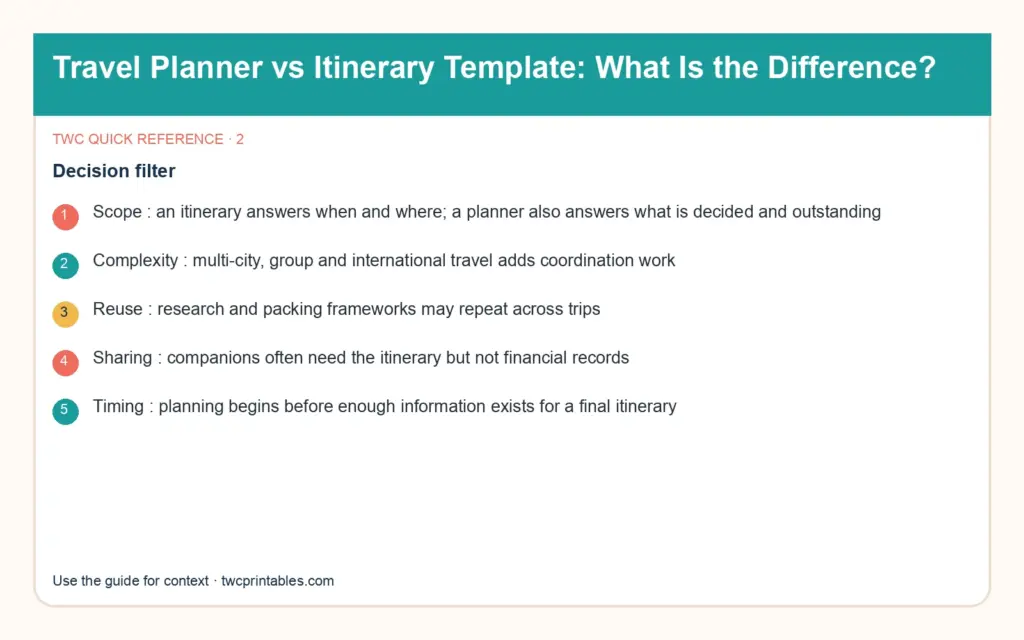
  • Scope: an itinerary answers when and where; a planner also answers what is decided and outstanding.
  • Complexity: multi-city, group and international travel adds coordination work.
  • Reuse: research and packing frameworks may repeat across trips.
  • Sharing: companions often need the itinerary but not financial records.
  • Timing: planning begins before enough information exists for a final itinerary.
Person working through a practical travel planner vs itinerary template process

Build it step by step

Work through these in order the first time. Once the system is familiar, your regular review can be wonderfully short.

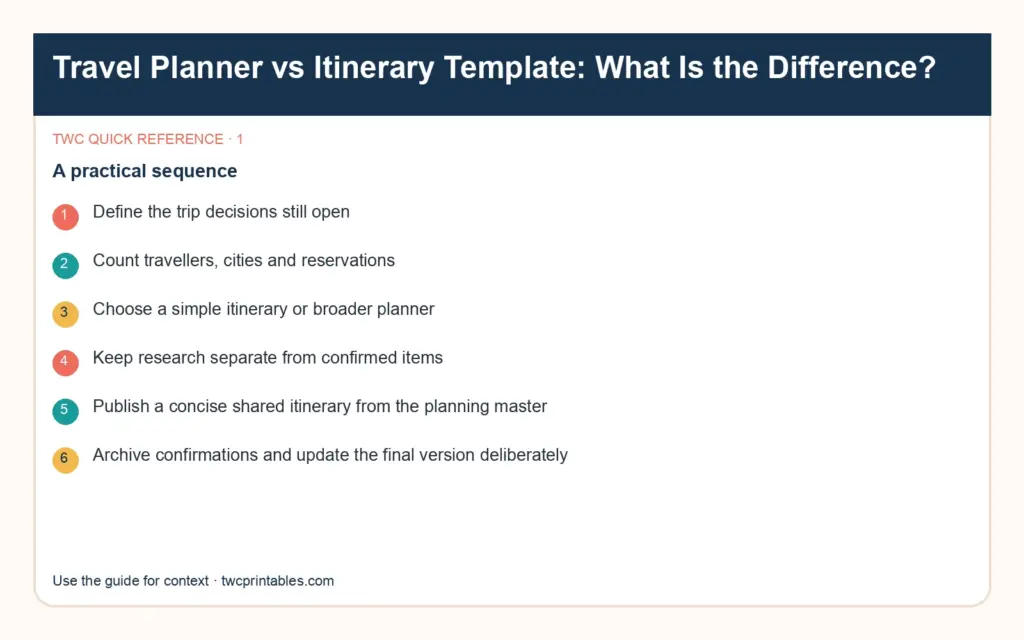
1. Define the trip decisions still open

Begin here before you add anything optional. A clear starting point saves a surprising amount of rework later.

2. Count travellers, cities and reservations

Keep this information together in one place. When the facts are easy to find, the next decision becomes much simpler.

3. Choose a simple itinerary or broader planner

Now shape the plan around what is actually available—your real time, tools, budget and capacity.

4. Keep research separate from confirmed items

This is where the plan becomes flexible. Leave enough breathing room for the ordinary changes real life brings.

5. Publish a concise shared itinerary from the planning master

Do a practical check before moving on. Make sure the people, dates, quantities and access details still line up.

6. Archive confirmations and update the final version deliberately

Finish with a simple review rule: keep what helps, remove what does not, and update only the part that changed.

Original decision diagram 1 for travel planner vs itinerary template

A real-life example

A two-night road trip with one hotel may need a single itinerary. A ten-day group trip across three cities needs budget, booking status, rooming, responsibilities and packing records before a shareable itinerary can be produced. The itinerary is an output of the larger planning process.

Notice the pattern: the plan holds the useful details, but it still leaves room for a human day. That is the sweet spot.

Original decision diagram 2 for travel planner vs itinerary template

Four easy traps to avoid

Calling a list of attractions an itinerary

Pause and return to the first decision. Clarity now is far more useful than extra detail built on the wrong assumption. Try this instead: Count travellers, cities and reservations.

Sharing financial and identity records with the full group

Bring this back to one trusted source of truth so you are not maintaining the same information in several places. Try this instead: Choose a simple itinerary or broader planner.

Maintaining separate unconnected booking and schedule files

Test the smallest workable version first. You can add more once the page has earned a place in the routine. Try this instead: Keep research separate from confirmed items.

Choosing a large planner for a trip with almost no coordination

Add a reset point. A useful system should help you continue after a change, not make you feel as though you have failed it. Try this instead: Publish a concise shared itinerary from the planning master.

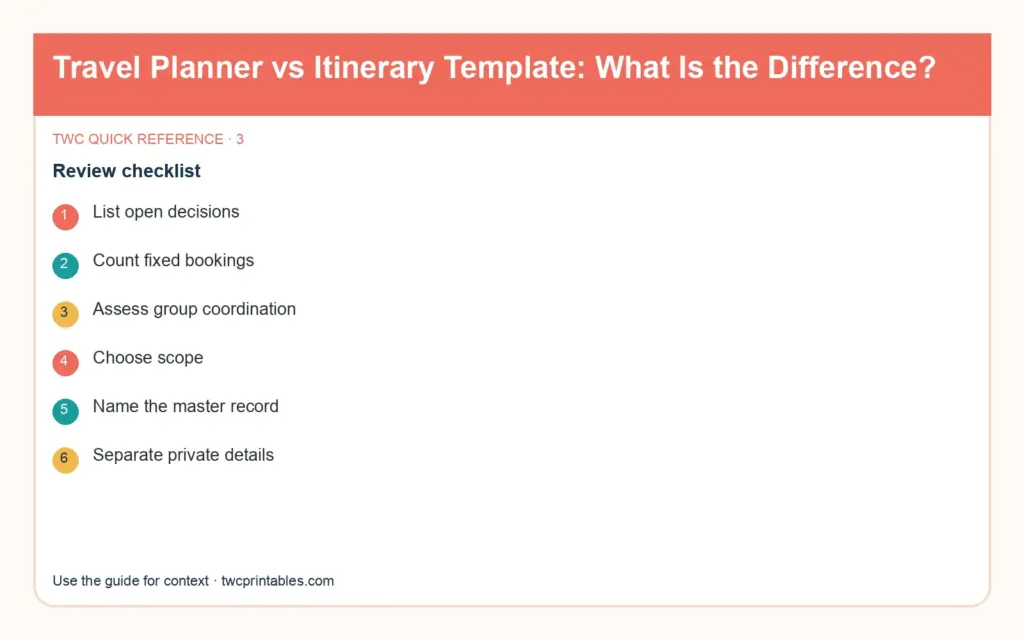
Original decision diagram 3 for travel planner vs itinerary template

Your ready-to-use checklist

Use this as a cheerful final check—not another list you have to manage perfectly. If the important details are covered, you are ready to begin.

  • List open decisions.
  • Count fixed bookings.
  • Assess group coordination.
  • Choose scope.
  • Name the master record.
  • Separate private details.
  • Export a shareable itinerary.
  • Version the final copy.
Original decision diagram 4 for travel planner vs itinerary template

Keep the key details close

Key facts

Best starting point
A travel planner manages the whole trip—research, budget, bookings, packing and contingencies—while an itinerary orders what happens by day and time. Use only an itinerary for a simple trip; use a planner with an itinerary module when decisions, people or destinations multiply.
Plan around
Scope, Complexity, Reuse, Sharing and Timing
Recommended editable template
Canva Planner Bundle | BRIGHT Source

Frequently asked questions

Frequently asked questions

What is the best template for creating a travel itinerary?

A travel planner manages the whole trip—research, budget, bookings, packing and contingencies—while an itinerary orders what happens by day and time. Use only an itinerary for a simple trip; use a planner with an itinerary module when decisions, people or destinations multiply.

What should I decide before I begin?

Start with scope, complexity and reuse. Those choices shape the pages, level of detail and routine that will actually be useful.

Can an editable Canva template make this easier?

Yes. An editable Canva template can remove the layout work and give every important detail a clear home. Start with the pages you will genuinely use, customize the colours, fonts and wording, and leave optional pages out until they prove helpful.

What is the simplest way to put this into practice?

Begin with define the trip decisions still open, count travellers, cities and reservations and choose a simple itinerary or broader planner. Use the smallest complete version for one real cycle, then keep what helps and simplify what does not.


Ready for a beautiful head start?

Bring your planning pages into one cheerful, coordinated Canva system, then choose only the layouts that fit the way you really plan.

Sources and review note

The sources below were reviewed for this guide on 26 August 2026. Platform features, prices, policies and legal requirements can change, so confirm the current official terms whenever a decision has legal, financial, health or account consequences.

Sources

  1. Traveler’s Checklist — U.S. Department of State (accessed )

Reviewed and updated by TWCprintables Editorial Team.