How to Meal Plan for a Week Without Wasting Food

Planning feels much easier when the important details already have a clear place to live.

Meal planning without waste starts with what must be used, who will eat and which evenings have real cooking capacity. Build the week around inventory and constraints, deliberately reuse ingredients, then buy only the gap between the plan and what is already available.

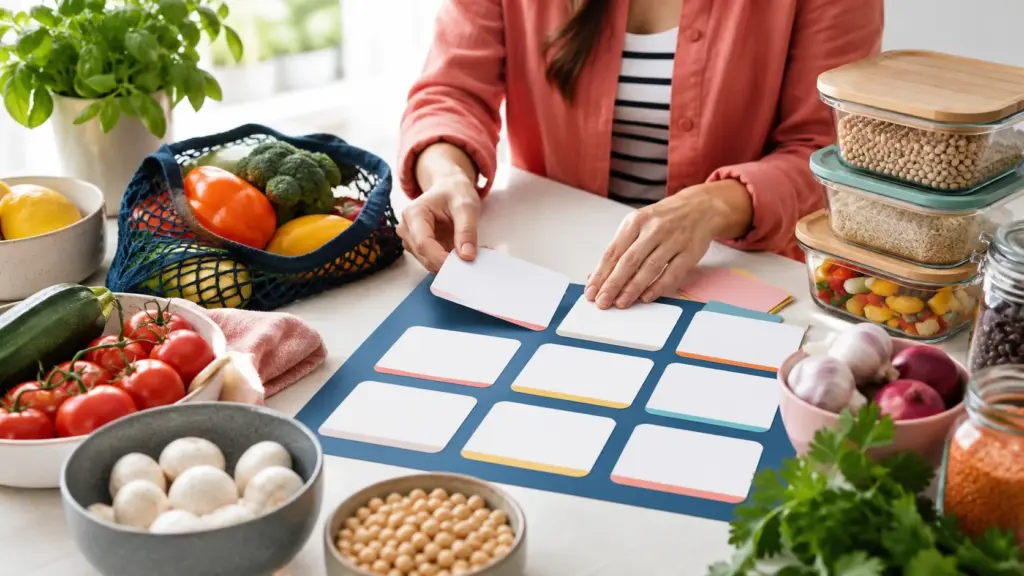
Overhead editorial concept introducing how to meal plan

The short version

In this guide

The details that make the plan work

Planning feels much easier when the important details already have a clear place to live. Meal planning without waste starts with what must be used, who will eat and which evenings have real cooking capacity. Build the week around inventory and constraints, deliberately reuse ingredients, then buy only the gap between the plan and what is already available.

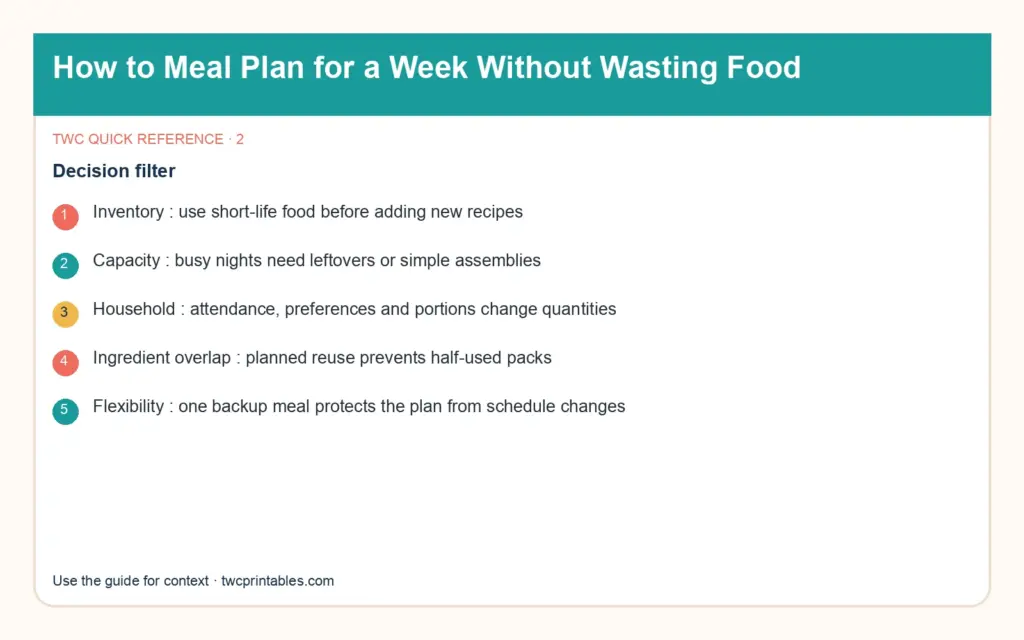
  • Inventory: use short-life food before adding new recipes.
  • Capacity: busy nights need leftovers or simple assemblies.
  • Household: attendance, preferences and portions change quantities.
  • Ingredient overlap: planned reuse prevents half-used packs.
  • Flexibility: one backup meal protects the plan from schedule changes.
Person working through a practical how to meal plan process

Build it step by step

Work through these in order the first time. Once the system is familiar, your regular review can be wonderfully short.

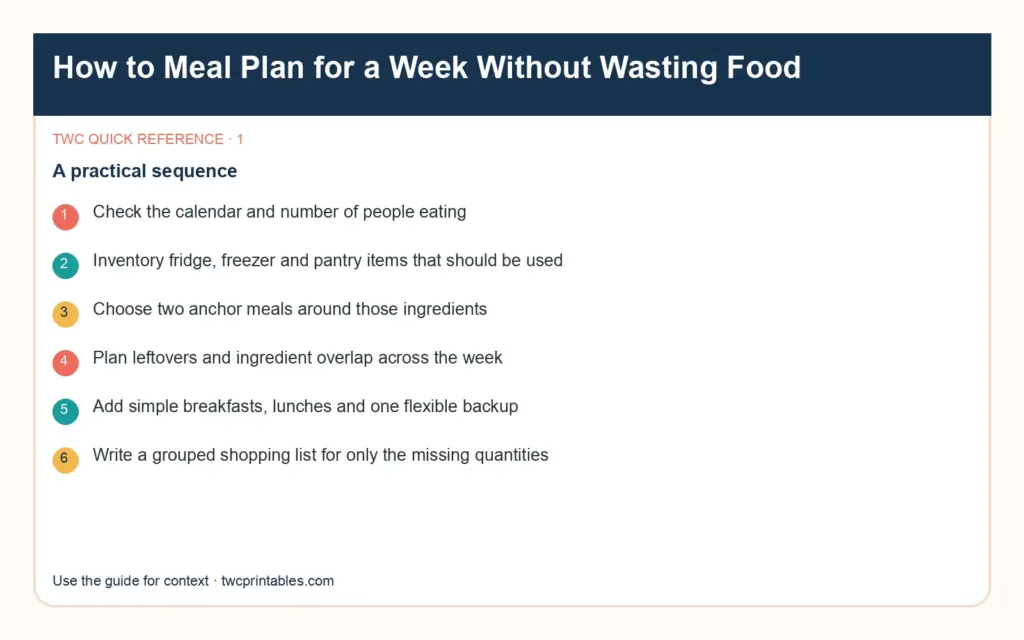
1. Check the calendar and number of people eating

Begin here before you add anything optional. A clear starting point saves a surprising amount of rework later.

2. Inventory fridge, freezer and pantry items that should be used

Keep this information together in one place. When the facts are easy to find, the next decision becomes much simpler.

3. Choose two anchor meals around those ingredients

Now shape the plan around what is actually available—your real time, tools, budget and capacity.

4. Plan leftovers and ingredient overlap across the week

This is where the plan becomes flexible. Leave enough breathing room for the ordinary changes real life brings.

5. Add simple breakfasts, lunches and one flexible backup

Do a practical check before moving on. Make sure the people, dates, quantities and access details still line up.

6. Write a grouped shopping list for only the missing quantities

Finish with a simple review rule: keep what helps, remove what does not, and update only the part that changed.

Hands arranging the key steps for how to meal plan

A real-life example

A half bag of spinach, cooked rice and two late workdays shape the plan. Monday uses spinach in a pasta dish, Tuesday repurposes the remainder in eggs, and Wednesday turns rice into a quick bowl. Thursday is a frozen backup meal, leaving capacity for an unplanned change.

Notice the pattern: the plan holds the useful details, but it still leaves room for a human day. That is the sweet spot.

Original decision diagram 1 for how to meal plan

Four easy traps to avoid

Choosing seven unrelated recipes before checking food

Pause and return to the first decision. Clarity now is far more useful than extra detail built on the wrong assumption. Try this instead: Inventory fridge, freezer and pantry items that should be used.

Planning ambitious cooking on the busiest evenings

Bring this back to one trusted source of truth so you are not maintaining the same information in several places. Try this instead: Choose two anchor meals around those ingredients.

Writing a shopping list without quantities

Test the smallest workable version first. You can add more once the page has earned a place in the routine. Try this instead: Plan leftovers and ingredient overlap across the week.

Treating leftovers as accidental rather than scheduled

Add a reset point. A useful system should help you continue after a change, not make you feel as though you have failed it. Try this instead: Add simple breakfasts, lunches and one flexible backup.

Original decision diagram 2 for how to meal plan

Your ready-to-use checklist

Use this as a cheerful final check—not another list you have to manage perfectly. If the important details are covered, you are ready to begin.

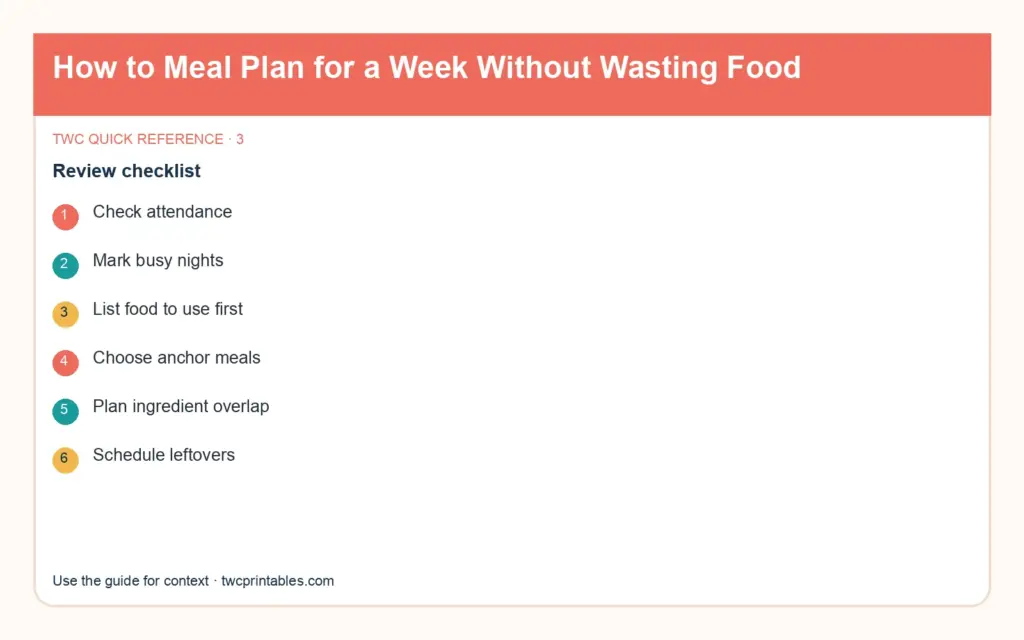
  • Check attendance.
  • Mark busy nights.
  • List food to use first.
  • Choose anchor meals.
  • Plan ingredient overlap.
  • Schedule leftovers.
  • Add one backup meal.
  • Buy only the gaps.
Original decision diagram 3 for how to meal plan

Keep the key details close

Key facts

Best starting point
Meal planning without waste starts with what must be used, who will eat and which evenings have real cooking capacity. Build the week around inventory and constraints, deliberately reuse ingredients, then buy only the gap between the plan and what is already available.
Plan around
Inventory, Capacity, Household, Ingredient overlap and Flexibility
Recommended editable template
2026 Planner Canva Templates | BRIGHT Source

Frequently asked questions

Frequently asked questions

How to meal plan for beginners?

Meal planning without waste starts with what must be used, who will eat and which evenings have real cooking capacity. Build the week around inventory and constraints, deliberately reuse ingredients, then buy only the gap between the plan and what is already available.

What should I decide before I begin?

Start with inventory, capacity and household. Those choices shape the pages, level of detail and routine that will actually be useful.

Can an editable Canva template make this easier?

Yes. An editable Canva template can remove the layout work and give every important detail a clear home. Start with the pages you will genuinely use, customize the colours, fonts and wording, and leave optional pages out until they prove helpful.

What is the simplest way to put this into practice?

Begin with check the calendar and number of people eating, inventory fridge, freezer and pantry items that should be used and choose two anchor meals around those ingredients. Use the smallest complete version for one real cycle, then keep what helps and simplify what does not.


Ready for a beautiful head start?

Keep calendars, meals, habits, goals and everyday details in one bright, editable annual planner instead of rebuilding the basics each week.

Sources and review note

The sources below were reviewed for this guide on 26 August 2026. Platform features, prices, policies and legal requirements can change, so confirm the current official terms whenever a decision has legal, financial, health or account consequences.

Sources

  1. Meal Planning — USDA MyPlate (accessed )
  2. FoodKeeper App — FoodSafety.gov (accessed )

Reviewed and updated by TWCprintables Editorial Team.