Meal Planning on a Budget: A Repeatable Weekly System

Planning feels much easier when the important details already have a clear place to live.

Budget meal planning is constraint-first: set the week’s food limit, protect nutrition and household needs, use current inventory, then choose flexible meals built from affordable overlapping ingredients. Track actual spend and leftovers so next week improves.

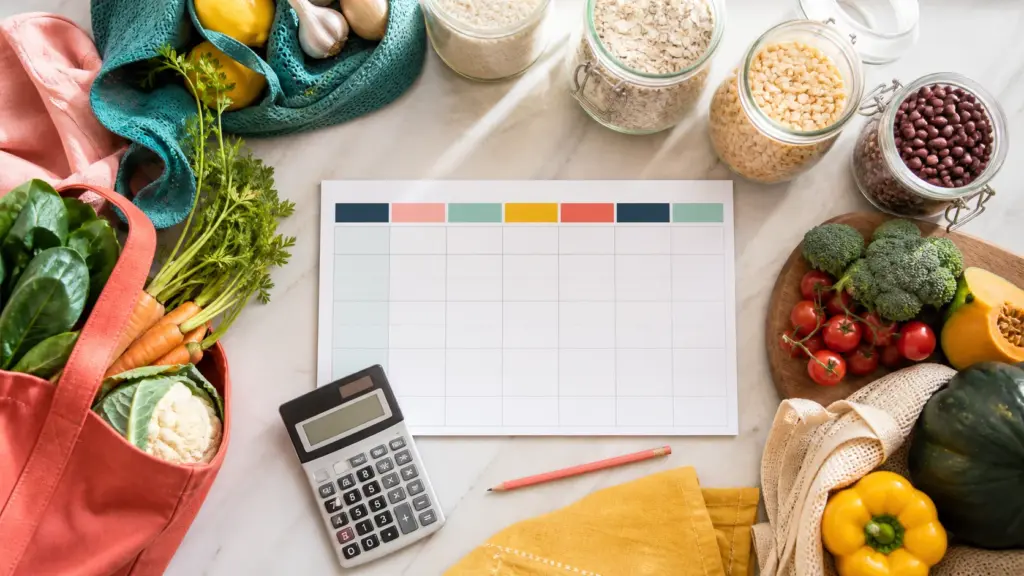
Overhead editorial concept introducing meal planning on a budget

The short version

In this guide

The details that make the plan work

Planning feels much easier when the important details already have a clear place to live. Budget meal planning is constraint-first: set the week’s food limit, protect nutrition and household needs, use current inventory, then choose flexible meals built from affordable overlapping ingredients. Track actual spend and leftovers so next week improves.

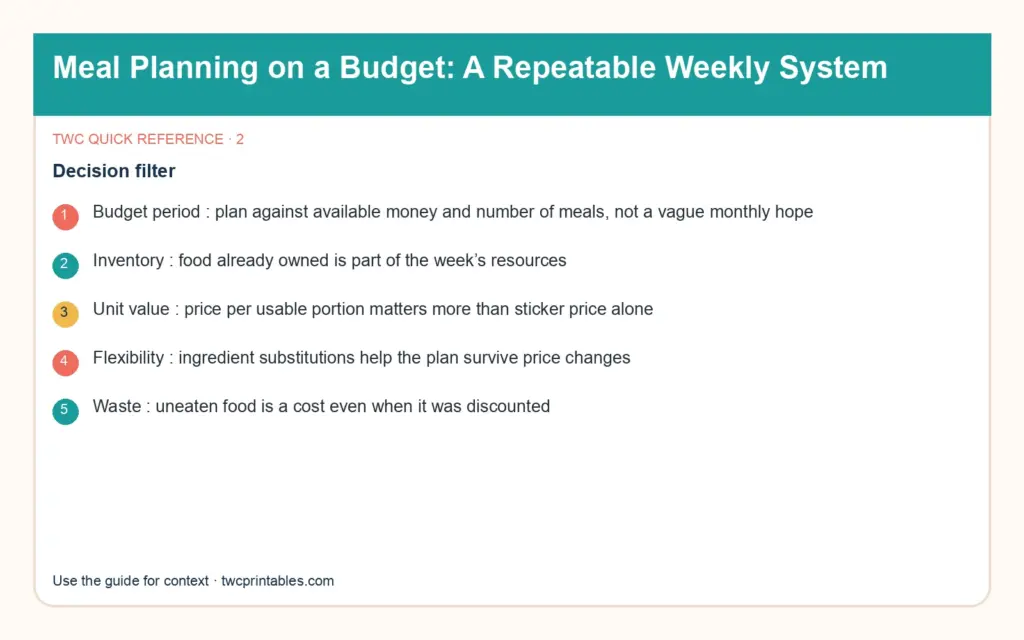
  • Budget period: plan against available money and number of meals, not a vague monthly hope.
  • Inventory: food already owned is part of the week’s resources.
  • Unit value: price per usable portion matters more than sticker price alone.
  • Flexibility: ingredient substitutions help the plan survive price changes.
  • Waste: uneaten food is a cost even when it was discounted.
Person working through a practical meal planning on a budget process

Build it step by step

Work through these in order the first time. Once the system is familiar, your regular review can be wonderfully short.

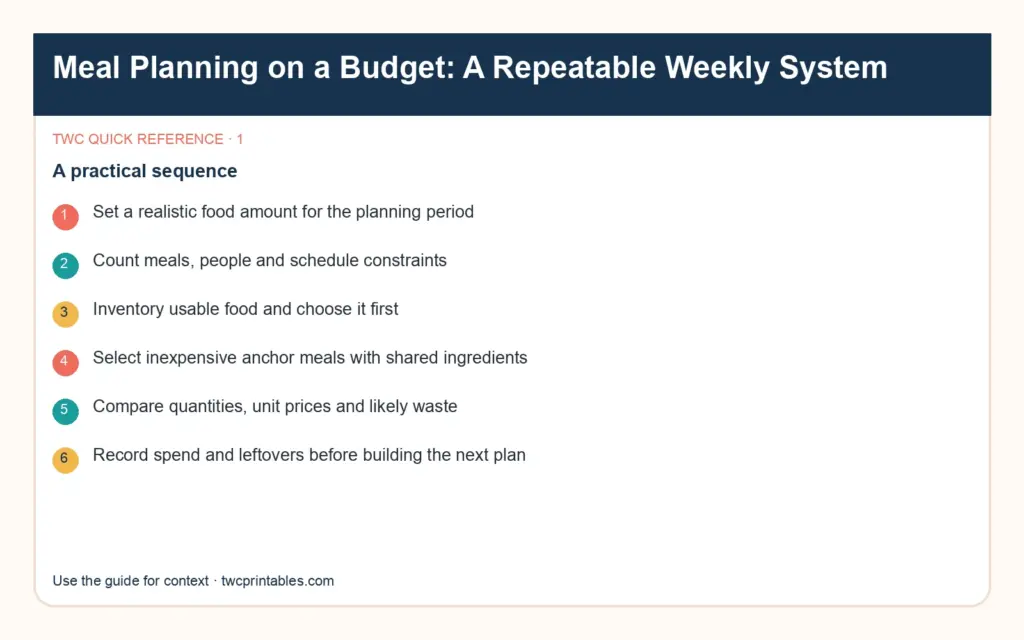
1. Set a realistic food amount for the planning period

Begin here before you add anything optional. A clear starting point saves a surprising amount of rework later.

2. Count meals, people and schedule constraints

Keep this information together in one place. When the facts are easy to find, the next decision becomes much simpler.

3. Inventory usable food and choose it first

Now shape the plan around what is actually available—your real time, tools, budget and capacity.

4. Select inexpensive anchor meals with shared ingredients

This is where the plan becomes flexible. Leave enough breathing room for the ordinary changes real life brings.

5. Compare quantities, unit prices and likely waste

Do a practical check before moving on. Make sure the people, dates, quantities and access details still line up.

6. Record spend and leftovers before building the next plan

Finish with a simple review rule: keep what helps, remove what does not, and update only the part that changed.

Original decision diagram 1 for meal planning on a budget

A real-life example

A week uses oats, rice, beans, eggs and seasonal vegetables across breakfasts, bowls, soup and a quick fried-rice dinner. One flexible protein can be swapped according to the best available price. The plan reserves a small amount for milk or produce that runs out midweek.

Notice the pattern: the plan holds the useful details, but it still leaves room for a human day. That is the sweet spot.

Original decision diagram 2 for meal planning on a budget

Four easy traps to avoid

Building a cheap menu that no one will eat

Pause and return to the first decision. Clarity now is far more useful than extra detail built on the wrong assumption. Try this instead: Count meals, people and schedule constraints.

Buying bulk without a storage or use plan

Bring this back to one trusted source of truth so you are not maintaining the same information in several places. Try this instead: Inventory usable food and choose it first.

Comparing package price instead of usable servings

Test the smallest workable version first. You can add more once the page has earned a place in the routine. Try this instead: Select inexpensive anchor meals with shared ingredients.

Planning every meal so tightly that one disruption causes takeaway spending

Add a reset point. A useful system should help you continue after a change, not make you feel as though you have failed it. Try this instead: Compare quantities, unit prices and likely waste.

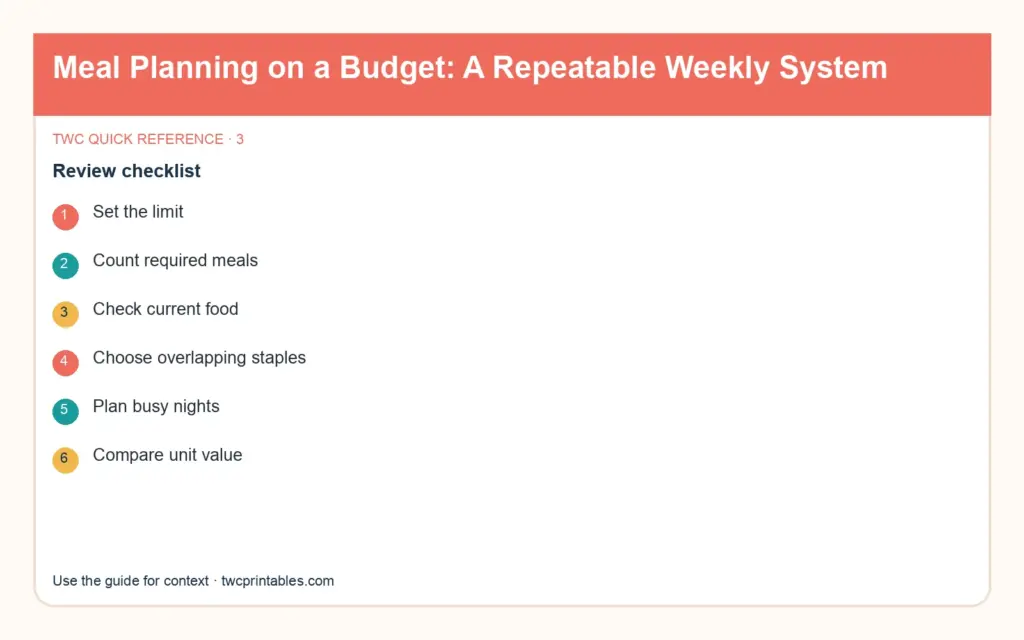
Original decision diagram 3 for meal planning on a budget

Your ready-to-use checklist

Use this as a cheerful final check—not another list you have to manage perfectly. If the important details are covered, you are ready to begin.

  • Set the limit.
  • Count required meals.
  • Check current food.
  • Choose overlapping staples.
  • Plan busy nights.
  • Compare unit value.
  • Keep a small flex amount.
  • Record actual spend and waste.
Original decision diagram 4 for meal planning on a budget

Keep the key details close

Key facts

Best starting point
Budget meal planning is constraint-first: set the week’s food limit, protect nutrition and household needs, use current inventory, then choose flexible meals built from affordable overlapping ingredients. Track actual spend and leftovers so next week improves.
Plan around
Budget period, Inventory, Unit value, Flexibility and Waste
Recommended editable template
Finances Kit Templates for Canva Source

Frequently asked questions

Frequently asked questions

What is the 3-3-3 rule for meal prep?

Budget meal planning is constraint-first: set the week’s food limit, protect nutrition and household needs, use current inventory, then choose flexible meals built from affordable overlapping ingredients. Track actual spend and leftovers so next week improves.

What should I decide before I begin?

Start with budget period, inventory and unit value. Those choices shape the pages, level of detail and routine that will actually be useful.

Can an editable Canva template make this easier?

Yes. An editable Canva template can remove the layout work and give every important detail a clear home. Start with the pages you will genuinely use, customize the colours, fonts and wording, and leave optional pages out until they prove helpful.

What is the simplest way to put this into practice?

Begin with set a realistic food amount for the planning period, count meals, people and schedule constraints and inventory usable food and choose it first. Use the smallest complete version for one real cycle, then keep what helps and simplify what does not.

Ready for a beautiful head start?

Turn the important numbers into a routine you can actually review with bright, editable finance-planning pages.

Sources and review note

The sources below were reviewed for this guide on 26 August 2026. Platform features, prices, policies and legal requirements can change, so confirm the current official terms whenever a decision has legal, financial, health or account consequences.

Sources

  1. Meal Planning — USDA MyPlate (accessed )
  2. FoodKeeper App — FoodSafety.gov (accessed )

Reviewed and updated by TWCprintables Editorial Team.