How to Choose an ADHD-Friendly Planner Without Adding More Overwhelm

The most useful planner is the one that still makes sense on an ordinary, slightly messy day.

An ADHD-friendly planner reduces steps, keeps the current plan visible and makes restarting easy. Choose from your specific friction—time awareness, prioritisation, working memory or task initiation—and test one simple weekly workflow before buying a large system.

Overhead editorial concept introducing best planner for adhd adults

The short version

In this guide

The details that make the plan work

The most useful planner is the one that still makes sense on an ordinary, slightly messy day. An ADHD-friendly planner reduces steps, keeps the current plan visible and makes restarting easy. Choose from your specific friction—time awareness, prioritisation, working memory or task initiation—and test one simple weekly workflow before buying a large system.

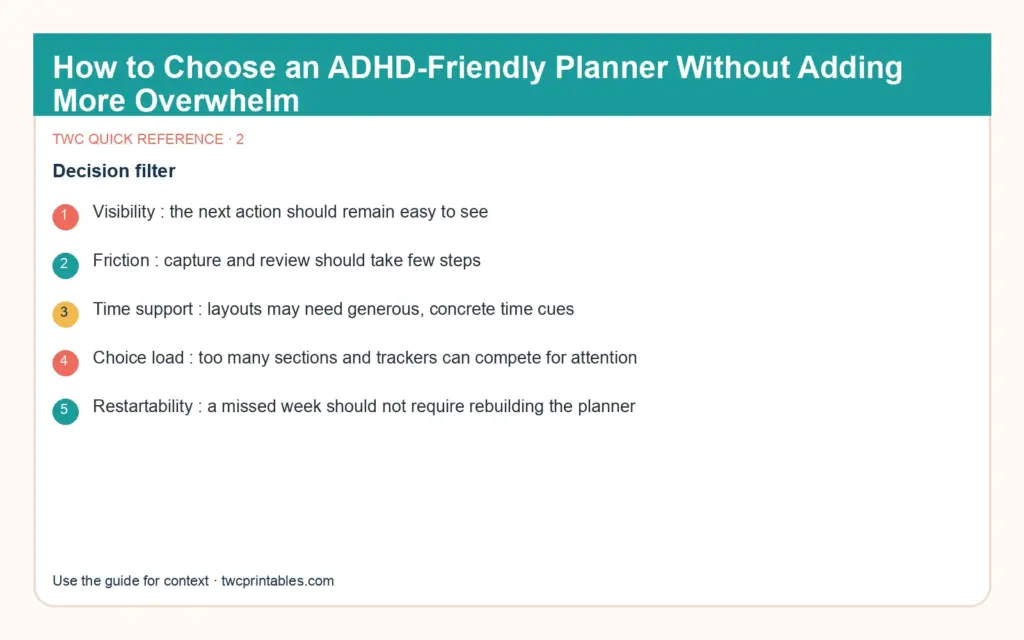
  • Visibility: the next action should remain easy to see.
  • Friction: capture and review should take few steps.
  • Time support: layouts may need generous, concrete time cues.
  • Choice load: too many sections and trackers can compete for attention.
  • Restartability: a missed week should not require rebuilding the planner.
Person working through a practical best planner for adhd adults process

Build it step by step

Work through these in order the first time. Once the system is familiar, your regular review can be wonderfully short.

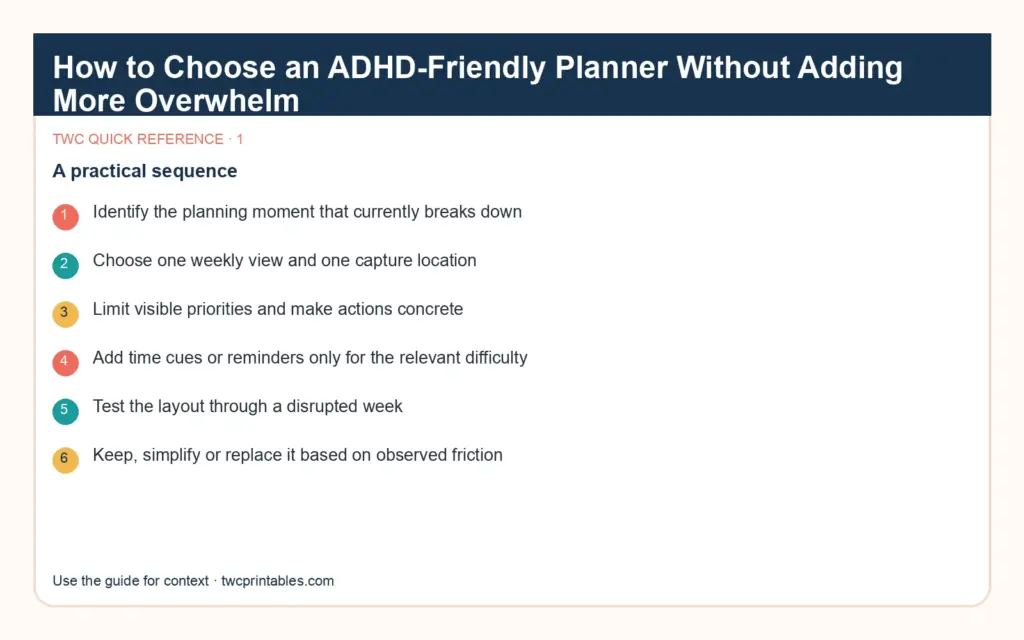
1. Identify the planning moment that currently breaks down

Begin here before you add anything optional. A clear starting point saves a surprising amount of rework later.

2. Choose one weekly view and one capture location

Keep this information together in one place. When the facts are easy to find, the next decision becomes much simpler.

3. Limit visible priorities and make actions concrete

Now shape the plan around what is actually available—your real time, tools, budget and capacity.

4. Add time cues or reminders only for the relevant difficulty

This is where the plan becomes flexible. Leave enough breathing room for the ordinary changes real life brings.

5. Test the layout through a disrupted week

Do a practical check before moving on. Make sure the people, dates, quantities and access details still line up.

6. Keep, simplify or replace it based on observed friction

Finish with a simple review rule: keep what helps, remove what does not, and update only the part that changed.

Hands arranging the key steps for best planner for adhd adults

A real-life example

Someone who forgets tasks may need a visible capture-and-review loop; someone who sees tasks but cannot start may need tiny next actions and a focus box. A colourful 100-page planner is not inherently ADHD-friendly. Fit depends on which friction it removes in daily use.

Notice the pattern: the plan holds the useful details, but it still leaves room for a human day. That is the sweet spot.

Original decision diagram 1 for best planner for adhd adults

Four easy traps to avoid

Buying from an ADHD label without inspecting the workflow

Pause and return to the first decision. Clarity now is far more useful than extra detail built on the wrong assumption. Try this instead: Choose one weekly view and one capture location.

Adding many trackers to create motivation

Bring this back to one trusted source of truth so you are not maintaining the same information in several places. Try this instead: Limit visible priorities and make actions concrete.

Hiding the current week behind several sections

Test the smallest workable version first. You can add more once the page has earned a place in the routine. Try this instead: Add time cues or reminders only for the relevant difficulty.

Treating a missed review as failure instead of using a restart rule

Add a reset point. A useful system should help you continue after a change, not make you feel as though you have failed it. Try this instead: Test the layout through a disrupted week.

Original decision diagram 2 for best planner for adhd adults

Your ready-to-use checklist

Use this as a cheerful final check—not another list you have to manage perfectly. If the important details are covered, you are ready to begin.

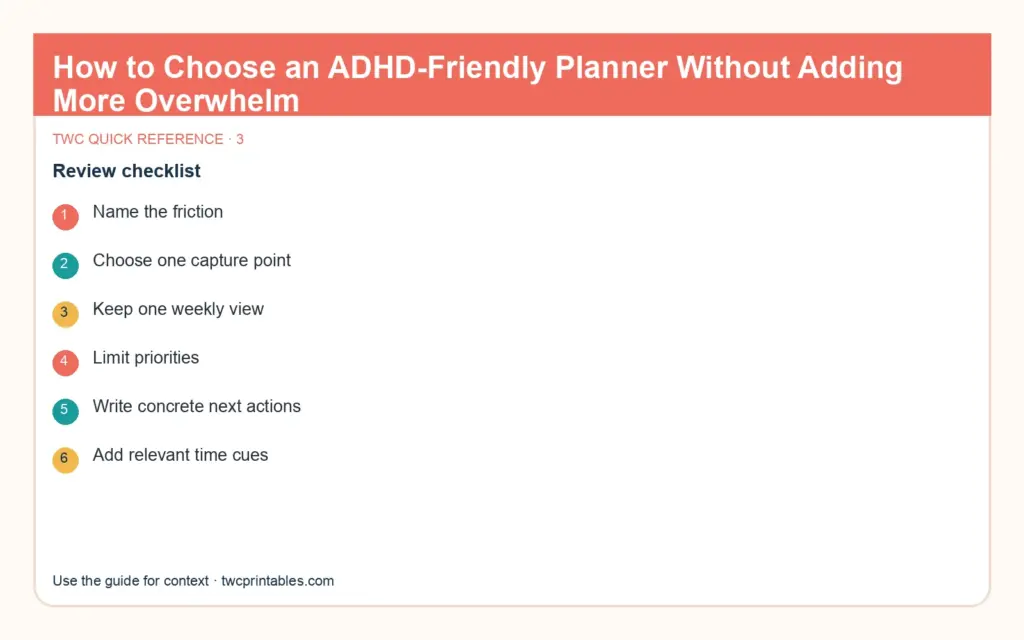
  • Name the friction.
  • Choose one capture point.
  • Keep one weekly view.
  • Limit priorities.
  • Write concrete next actions.
  • Add relevant time cues.
  • Test during disruption.
  • Use a simple restart rule.
Original decision diagram 3 for best planner for adhd adults

Keep the key details close

Key facts

Best starting point
An ADHD-friendly planner reduces steps, keeps the current plan visible and makes restarting easy. Choose from your specific friction—time awareness, prioritisation, working memory or task initiation—and test one simple weekly workflow before buying a large system.
Plan around
Visibility, Friction, Time support, Choice load and Restartability
Recommended editable template
Weekly Planner Kit Templates for Canva Source

Frequently asked questions

Frequently asked questions

What is the 10-3 rule for ADHD?

An ADHD-friendly planner reduces steps, keeps the current plan visible and makes restarting easy. Choose from your specific friction—time awareness, prioritisation, working memory or task initiation—and test one simple weekly workflow before buying a large system.

What should I decide before I begin?

Start with visibility, friction and time support. Those choices shape the pages, level of detail and routine that will actually be useful.

Can an editable Canva template make this easier?

A planner can support visibility, time awareness and working memory, but it is a tool rather than medical treatment. Test one simple layout, keep the current plan visible and choose a format that is easy to restart after an interruption.

What is the simplest way to put this into practice?

Begin with identify the planning moment that currently breaks down, choose one weekly view and one capture location and limit visible priorities and make actions concrete. Use the smallest complete version for one real cycle, then keep what helps and simplify what does not.


Ready for a beautiful head start?

Start with a ready-made set of editable weekly layouts, so you can test the view that feels clearest without designing every page from scratch.

Sources and review note

The sources below were reviewed for this guide on 26 August 2026. Platform features, prices, policies and legal requirements can change, so confirm the current official terms whenever a decision has legal, financial, health or account consequences.

Sources

  1. ADHD in Adults — Centers for Disease Control and Prevention (accessed )
  2. Attention-Deficit/Hyperactivity Disorder: What You Need to Know — National Institute of Mental Health (accessed )

Reviewed and updated by TWCprintables Editorial Team.